





Introduction
Factorio is widely regarded as one of the most meticulously designed games of the last decade. It teaches players to automate, optimize, and scale production systems with near-mathematical precision. What begins as a lone engineer hand-mining iron slowly transforms into a planet-spanning industrial machine, devouring resources at an exponential rate.
But as Factorio matured—and as its community collectively “solved” the game—a subtle but increasingly discussed issue emerged: the pursuit of perfect efficiency gradually undermines creativity, experimentation, and personal expression. This article explores how Factorio’s obsession with optimization, while brilliant, creates an automation trap that narrows playstyles and reshapes how players interact with the game.
From Survival Crafting to Industrial Ideology
Early Game Chaos and Improvisation
Factorio’s early hours are messy by design. Players handcraft components, build awkward conveyor layouts, and constantly fix shortages. Nothing is optimized, and every solution feels temporary.
This phase is rich in creativity. Players invent strange factory shapes, experiment with layouts, and adapt intuitively rather than systematically.
The Shift Toward Doctrine
As soon as basic automation stabilizes, the game subtly nudges players toward efficiency doctrine. Ratios matter. Throughput matters. Wasted space feels wrong.
The factory stops being a personal construction and starts becoming an engineering problem.
Optimization as the Core Fantasy
Efficiency Is the Game’s Language
Unlike sandbox builders, Factorio communicates success almost exclusively through efficiency metrics: items per second, belt saturation, power stability, and pollution management.
The game rewards solutions that are scalable, symmetrical, and mathematically clean.
When “Better” Becomes “Correct”
Over time, players internalize a single idea: there is a correct way to build.
Creative but inefficient designs are tolerated early, then abandoned as “mistakes” to be fixed later.
The Rise of the Blueprint Meta
Knowledge Compression
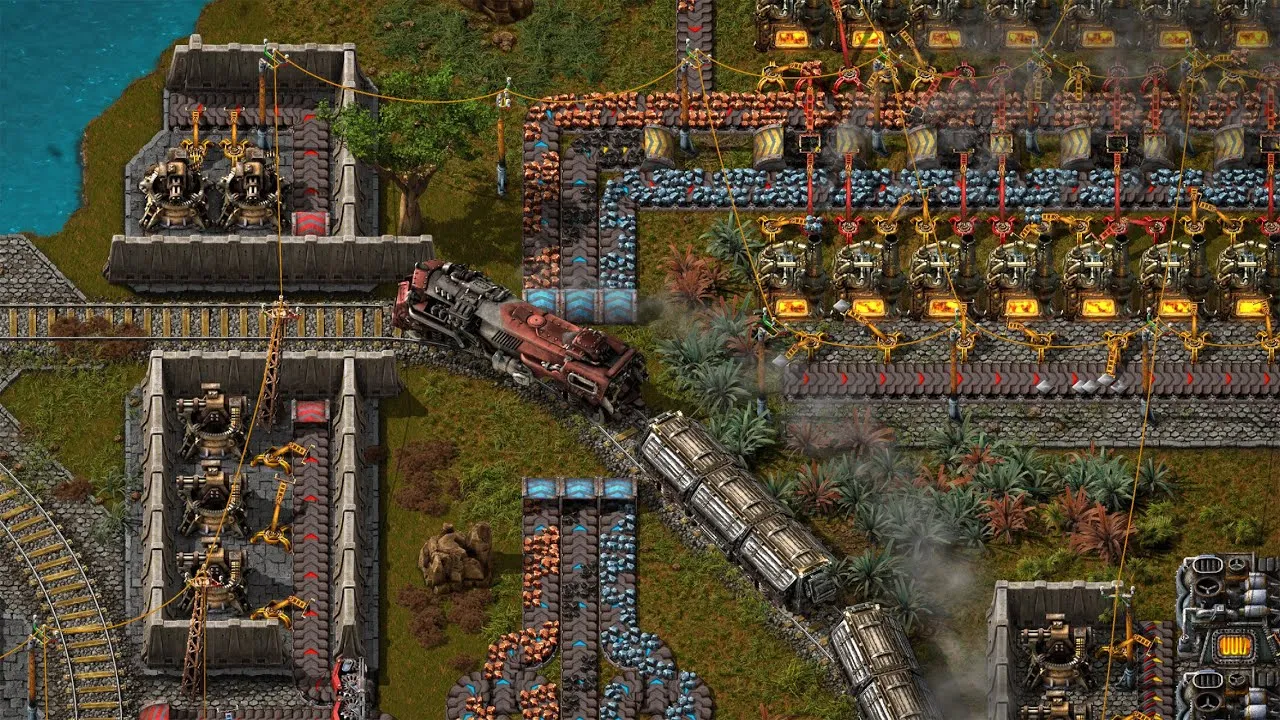
Blueprints allow players to save and share optimized designs. While this empowers large-scale construction, it also compresses discovery.
Entire sections of gameplay—oil processing, train junctions, circuit logic—can be skipped entirely by importing solutions.
Factories Built by the Internet
Many late-game factories are not designed by players, but assembled from community-approved modules.
The result is a factory that works perfectly, but tells no personal story.
When Solving the Game Reduces Play
The Problem of Optimal Ratios
Once players learn ideal ratios for science packs, smelting arrays, and production chains, decision-making narrows.
The question is no longer “What should I build?” but “How quickly can I replicate the known solution?”
Mastery Without Mystery
Factorio becomes predictable at high skill levels. Challenges remain complex, but rarely surprising.
The unknown—the fuel of creativity—is replaced by execution.
Megabases and the End of Improvisation
Scaling Magnifies Rigid Thinking
Megabases require strict planning. Mistakes are costly. Creative deviations risk catastrophic inefficiencies.
As scale increases, tolerance for experimentation decreases.
Factories as Machines, Not Places
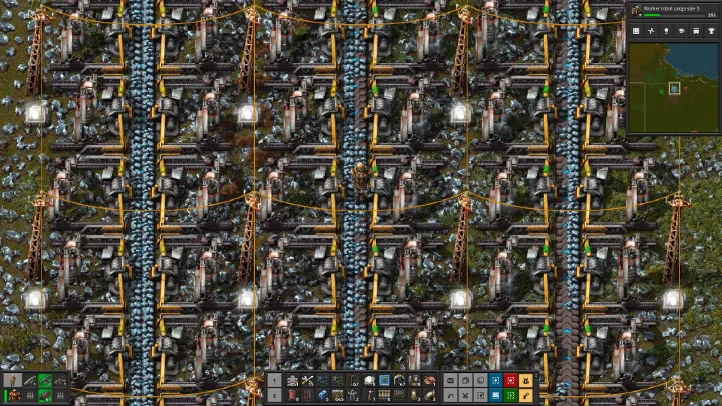
Large factories feel less like environments and more like systems diagrams brought to life.
They are impressive—but emotionally distant.
The Community’s Role in Narrowing Playstyles
Efficiency Culture Dominates Discourse
Community discussions overwhelmingly focus on optimization: UPS efficiency, perfect ratios, minimal pollution, maximal throughput.
Alternative playstyles exist—but are rarely celebrated.
Creativity Becomes a Subgenre
Artistic factories, unconventional layouts, or narrative-driven builds are treated as curiosities rather than valid end goals.
Factorio’s UI Reinforces the Trap
Numbers Over Feelings
Factorio’s interface emphasizes data clarity over ambiguity. Everything can be measured, inspected, and optimized.
This transparency is a strength—but it discourages intuition-driven play.
No Incentive for Aesthetic Choices
A beautiful factory is not more effective than an ugly one.
Without systemic reward, aesthetics become optional—and often abandoned.
Mods: Escape or Acceleration?
Mods That Increase Complexity
Some mods introduce new systems that temporarily restore uncertainty. However, they often lead to new optimization metas rather than creative freedom.
Mods That Encourage Expression
A smaller subset of mods emphasizes aesthetics, alternative progression, or narrative constraints—but these remain niche.
The dominant modding culture still prioritizes efficiency.
Why the Automation Trap Feels Inevitable
Factorio Teaches Players Too Well
The game excels at teaching optimization. Players internalize its logic completely.
Once learned, it’s difficult to unlearn—even if it reduces enjoyment.
Players Self-Enforce Constraints
Even when not required, players often choose the most efficient solution because inefficiency feels like failure.
The trap is psychological, not mechanical.
Lessons for Future Automation Games
Efficiency Should Compete With Other Values
Future games could reward:
- Aesthetic diversity
- Risk-taking designs
- Local inefficiencies that create global advantages
Mystery Must Be Preserved
Systems that resist full optimization help maintain curiosity and creativity.
Factorio’s clarity is powerful—but total clarity has a cost.
Why Factorio Still Succeeds Despite the Issue
A Game That Knows Its Identity
Factorio never pretends to be about self-expression. It is about mastery.
For many players, the automation trap is the appeal.
The Satisfaction of Total Control
Few games deliver the same sense of intellectual accomplishment.
The loss of creativity is, for some, a fair trade.
Conclusion
Factorio is a masterpiece of systems design—but its greatest strength also limits its long-term expressive potential. As players chase perfect efficiency, creativity narrows, experimentation fades, and factories become replicas of optimal theory rather than personal inventions.
This is not a failure of design, but a consequence of success. Factorio teaches optimization so effectively that players can forget why they started building in the first place.
In revealing this tension, Factorio offers a powerful lesson: when efficiency becomes absolute, creativity must fight to survive.
160-character summary
Factorio’s obsession with perfect efficiency gradually replaces creativity, turning personal factory design into rigid execution of solved systems.